

When I first stepped into the world of Assassin’s Creed Shadows, I immediately realized that Ubisoft had indeed taken a new stage in visual and sound performance. As an old player who has played Assassin’s Creed 2 all the way up to now, I can even say that the audio-visual performance of Shadow is no longer just a display of “technical power”, but a true “atmosphere revolution”.
This article will discuss my first perspective experience as a European and American player from the perspectives of vision, light and shadow, art, sound effects, and music.
Visual Presentation: Cinematic Lighting and a Strong Sense of Physicality
Environmental Rendering: Rich, Layered, and Fully Alive
What stood out to me right away wasn’t just the graphical fidelity, but the intentionality behind every visual element.
Forests feel layered and alive, mist moves naturally across the terrain, and villages soaked in rain reflect light with a striking sense of realism. It’s the kind of world where you find yourself slowing down simply to look around.
Lighting System: Beautiful—and Meaningful for Gameplay
Lighting in Shadows isn’t just there for aesthetics; it directly enhances the stealth experience.
When I slipped into the shadows, the global illumination system responded realistically, making stealth feel more tangible than ever. It’s one of the rare AC titles where light and darkness genuinely affect how I approach infiltration.
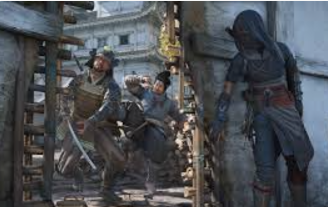
Character Models: Detailed, Textured, and Full of Weight
Close-up scenes are especially impressive.
Yasuke’s heavy armor reflects light differently than Naoe’s stealthy fabric gear, and both character models show off layers of scuffs, dirt, fibers, and surface detail. The textures feel surprisingly lifelike, contributing to the sense that these characters occupy a real physical world.
Animation Quality: Fluid, Natural, and Emotionally Grounded
Movement feels more grounded than in previous titles. Parkour, stealth, and combat animations flow together seamlessly, giving the whole game a more cinematic rhythm. This fluidity plays a big role in reinforcing immersion.
Art Direction: A Balance Between Authenticity and Dramatic Flair
Games set in Japan often fall into one of two traps: stylized clichés or overly museum-like realism.
Shadows avoids both.
- Villages feel lived-in
- Castles are imposing without being exaggerated
- Natural landscapes are serene without looking like postcards
The result is a world that respects historical roots while still embracing the dramatic tone that defines the Assassin’s Creed franchise.
Sound Design: Directional, Atmospheric, and Incredibly Precise
Environmental Audio: A World That Breathes
Wind slipping through bamboo, the muffled hush of snowfall, distant village ambience—all of it feels carefully layered.
The environmental sound design does more than fill space; it shapes the mood of every location.
Combat Audio: Impactful and Character-Driven
Yasuke’s heavy strikes land with a powerful metallic resonance, while Naoe’s movements emphasize quick, sharp fabric shifts and breathy exertions.
The contrast between their sound profiles adds depth to their personalities without relying on dialogue.
Stealth and Spatial Awareness: Sound That Actually Matters
Directional audio is strong enough that I could track enemy movements purely by listening.
This level of precision is rare even among modern open-world games, and it dramatically enhances stealth gameplay.

Music: Subtle, Atmospheric, and Emotionally Effective
The soundtrack doesn’t demand attention—it supports the moment.
During exploration, the music often steps back to let environmental audio breathe. But when the score rises—during dramatic infiltration sequences or major narrative moments—it does so with emotional weight.
Traditional Japanese instrumentation blends naturally with modern cinematic scoring, avoiding stereotypical “samurai soundtrack” tropes while remaining accessible to Western ears.
Overall Impressions: The Most Atmospherically Mature AC Entry Yet
From a purely visual and audio standpoint, Assassin’s Creed Shadows feels like the franchise’s most cohesive and immersive installment to date.
Every system—lighting, texture detail, environmental audio, sound effects, music—works in harmony to build a world that feels alive.
It’s been years since an Assassin’s Creed title made me pause missions just to look around, or simply listen to the world.

Conclusion
If you care about atmosphere, environmental detail, audio immersion, or graphical refinement, Assassin’s Creed Shadows stands out as one of the most impressive AC entries in recent memory.










Leave a Reply